Journal Article
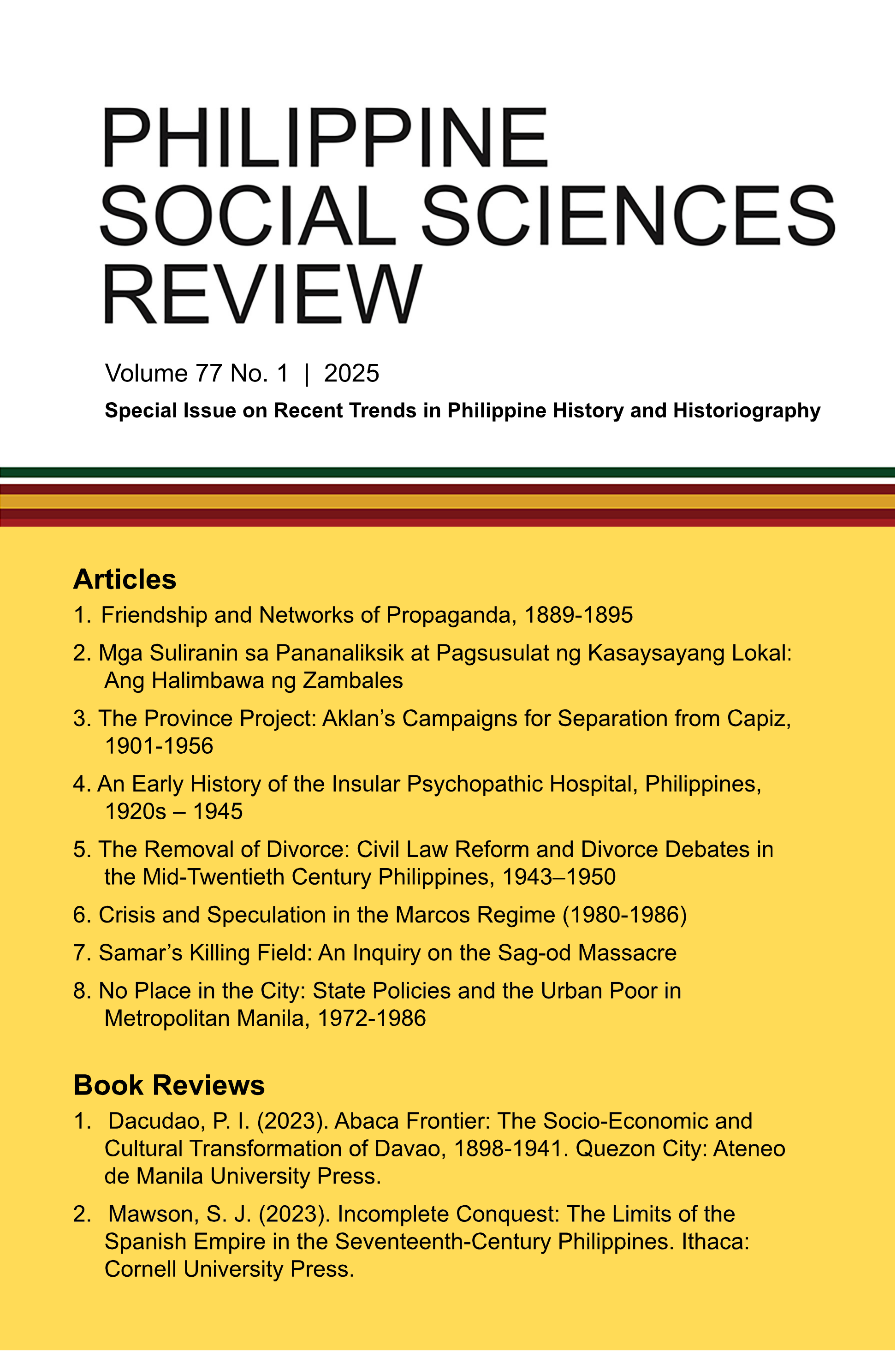
The Removal of Divorce: Civil Law Reform and Divorce Debates in the Mid-Twentieth Century Philippines, 1943–1950
Philippine Social Sciences Review
Abstract
This article examines the factors that explain the present status of the Philippines as one of the two remaining countries, alongside Vatican City State, where absolute divorce (marriage is dissolved; can remarry) is not legally recognized. After gaining independence, the Code Commission (1947) was formed to create a new Civil Code of the Philippines, intended to reform civil law, align it with the nation’s emerging identity, and depart from colonial legal legacies. Absolute divorce was removed from the original draft of the Civil Code during its deliberation in the First Congress in 1949. The Civil Code was enacted as Rep. Act 386 on June 18, 1949, which took effect in 1950. Unknown to many, however, the Philippines had two absolute divorce statutes: Act No. 2710 (1917) during the U.S. colonial regime and Exec. Order No. 141 (1943) under the Japanese occupation. Through examining a range of archival materials from congressional records to print media sources, this article demonstrates that Filipino lawmakers held complex and diverse opinions on absolute divorce, yet their arguments were commonly framed in terms of Catholic morality and preserving domestic happiness in Filipino families. It also argues that high divorce incidences (both during the Japanese period and in global divorce trends), election politics (1949 Philippine general elections), alongside the opposition coming from the Catholic church and Filipino women, served as decisive factors to abrogate absolute divorce. Instead, Congress institutionalized legal separation (marriage is not dissolved; cannot remarry)—a framework of marital separation that has endured from 1950 to the present.
Keywords
divorce
legal separation
civil law
legal history
Philippines
Read the publication
View Publication
Reach out to the researchers:

Lorenz Timothy Barco Ranera
lbranera@up.edu.ph