Public History in the Philippines: A National Conference
Published on 04 May 2026 | UP Department of History
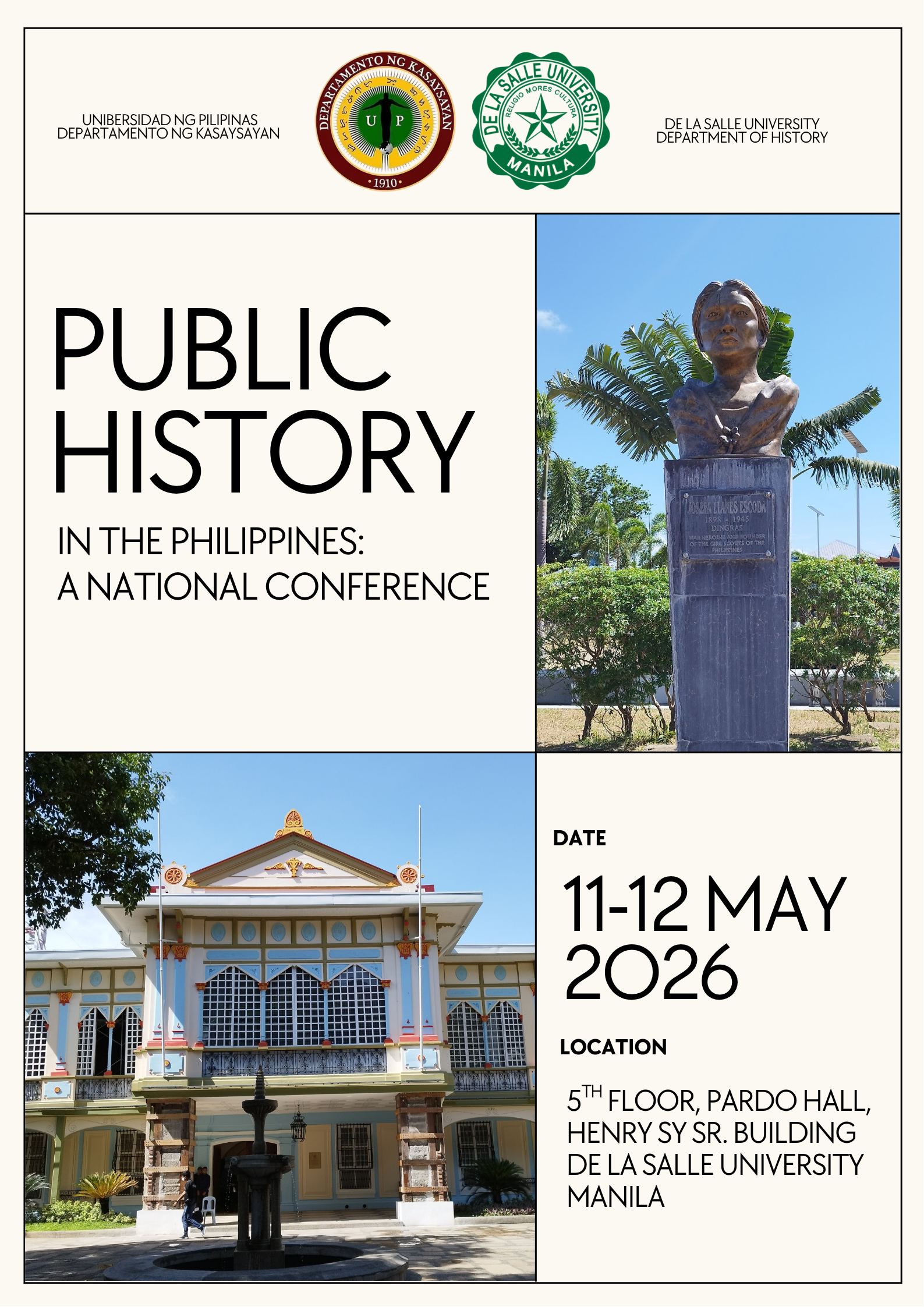
Date:
May 11, 2026-May 12, 2026
Convenors:
University of the Philippines Department of History
De La Salle University Department of History
De La Salle University Department of History
Venue:
5th Floor, Pardo Hall, Henry Sy. Jr. Building, De La Salle University Manila
Abstract:
Over the past two decades, public history in the Philippines has undergone a significant transformation. While it has long extended beyond the academe (through museums, commemorations, cultural institutions, popular media, and community memory practices), it now circulates with unprecedented speed and reach through high-grossing period films, digital platforms, community archives, and heritage mapping initiatives. This expansion has diversified the actors who shape public understandings of the past, from grassroots organizations to independent content creators. However, the same infrastructure that widens participation has also intensified contestation. Social media has become a volatile arena in which historical narratives are amplified, simplified, or distorted, as algorithm-driven visibility and political agendas often outpace scholarly verification and historical reflection. Public history in the Philippines today is therefore both vibrant and vulnerable.
This conference invites practitioners and stakeholders in public history to critically examine the current state and emerging trajectories of public history in the Philippines. It aims to offer a space for conversations across academic institutions, cultural organizations, and community-based initiatives about the shared challenges of preserving memory, narrating contested pasts, and making historical knowledge accessible to diverse audiences. The conference also welcomes the sharing of innovative practices that are reshaping public engagement with history, including digital archives, oral history projects, and heritage mapping initiatives, while assessing their possibilities and limitations. Central to this inquiry is a sustained reflection on ethical concerns surrounding representation, inclusivity, authority, and accessibility, particularly in contexts where historical narratives remain politically charged and socially uneven.
Over the past two decades, public history in the Philippines has undergone a significant transformation. While it has long extended beyond the academe (through museums, commemorations, cultural institutions, popular media, and community memory practices), it now circulates with unprecedented speed and reach through high-grossing period films, digital platforms, community archives, and heritage mapping initiatives. This expansion has diversified the actors who shape public understandings of the past, from grassroots organizations to independent content creators. However, the same infrastructure that widens participation has also intensified contestation. Social media has become a volatile arena in which historical narratives are amplified, simplified, or distorted, as algorithm-driven visibility and political agendas often outpace scholarly verification and historical reflection. Public history in the Philippines today is therefore both vibrant and vulnerable.
This conference invites practitioners and stakeholders in public history to critically examine the current state and emerging trajectories of public history in the Philippines. It aims to offer a space for conversations across academic institutions, cultural organizations, and community-based initiatives about the shared challenges of preserving memory, narrating contested pasts, and making historical knowledge accessible to diverse audiences. The conference also welcomes the sharing of innovative practices that are reshaping public engagement with history, including digital archives, oral history projects, and heritage mapping initiatives, while assessing their possibilities and limitations. Central to this inquiry is a sustained reflection on ethical concerns surrounding representation, inclusivity, authority, and accessibility, particularly in contexts where historical narratives remain politically charged and socially uneven.
View Program
Registration Closed. This Conference Has Concluded