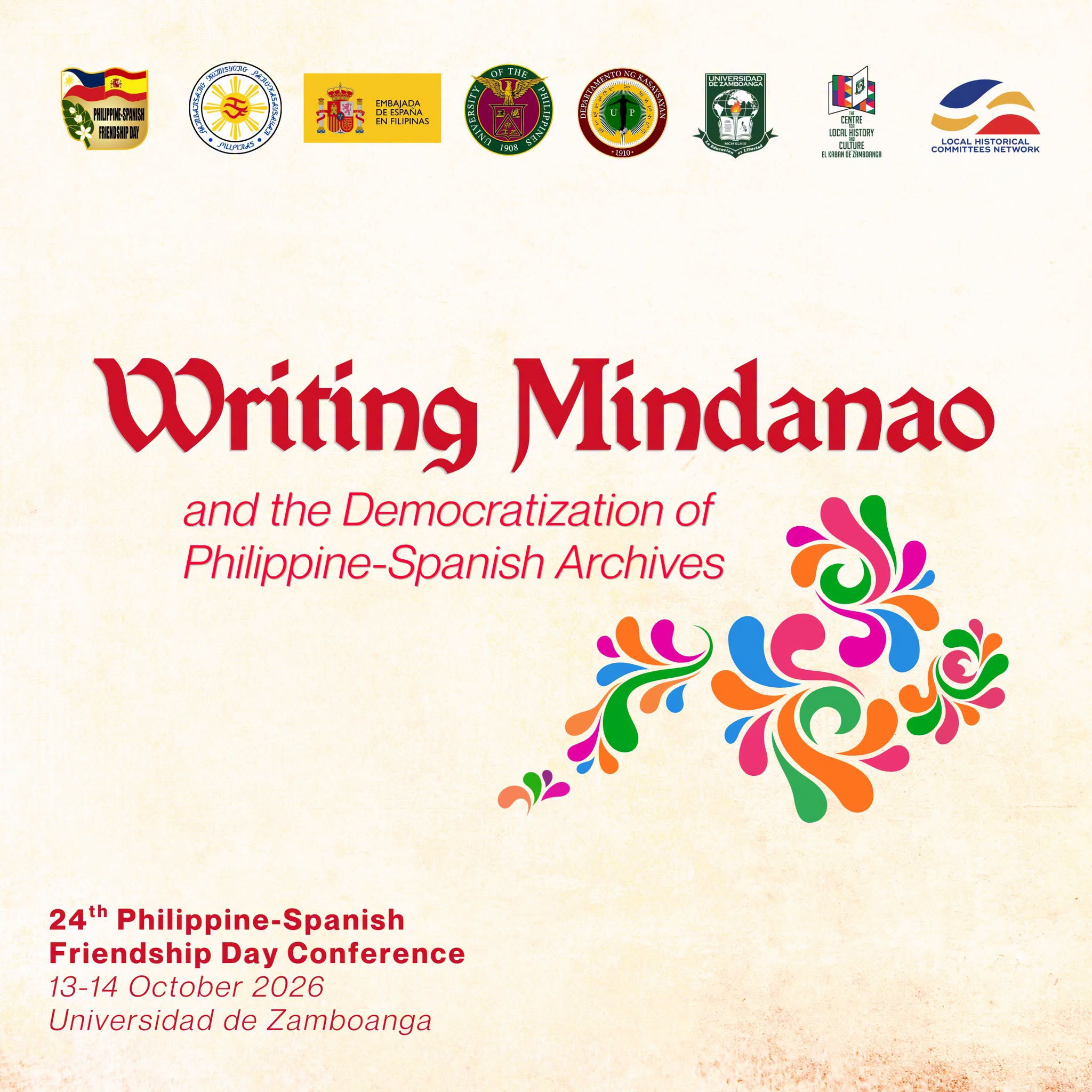
24th Philippine-Spanish Friendship Day International Conference
Published on 20 August 2026 | UP Department of History
Date:
October 13, 2026-October 14, 2026
Convenors:
Asst. Prof. Ian Christopher B. Alfonso, PhD
Asst. Prof. Janet S. Reguindin-Estella, PhD
Asst. Prof. Janet S. Reguindin-Estella, PhD
Venue:
Universidad de Zamboanga Main Campus, Don Toribio Street, Tetuan, Zamboanga City, 7000 Philippines
Abstract:
Historical Mindanao has many surviving records, including indigenous writings, as well as Portuguese, Dutch, and British accounts on economic and diplomatic encounters with its sultanates (Majul 1973; Laarhoven 1989; Arcilla 1990; Tan 1996, 2005; Tan and Bakuludan 1996; Hayase, Non, and Ulaen 1999; Casiño 2000; Schreurs 2000; Tiu 2005; Donoso 2010; Lopez 2019; Mastura 2023; Sousa Pinto, eds. 2025). In Isaac Donoso’s (2024) assessment, the materials in the Spanish archives alone on what we today call Bangsamoro are “enormous” and “will take several decades and generations of research to have a complete picture of preserved materials, and to offer to the historians edited and translated sources” (p. 150). And James Warren (1981) acknowledged that the trade documents between Manila and Sulu from 1768 to 1848, found in the Archivo General de Indias, were “among the most important sources” he used in his book The Sulu Zone (p. xiii). He also remarked that Sulu Sultante records from 1769 to 1898 “were still scattered, even unrecognized, in several European archives, and in Manila and Jakarta” (pp. xii–xiii).
With online repositories such as the Portal de Archivos Españoles, Biblioteca Nacional de España, Biblioteca Virtual de Defensa of Spain, and, most recently, the Globalise collection of VOC sources from the Dutch Nationaal Archief, one can now access important information about Mindanao’s history. And documents, whether discovered for the first time or reread through this democratized access, can, as William Henry Scott (1978) reminds us in Cracks in the parchment curtain, lead to fruitful reassessments of Mindanao’s past.
The theme of this year’s conference underscores the enrichment of discourse and methodology in writing, research, and the shaping of Mindanao’s history amid digital archives. It is hoped that digitized archival materials, maps, photographs, and ephemera online, especially from the archipelago’s colonial-era until the nineteenth century’s end, will enrich our understanding of Mindanao’s rich and proud history and heritage beyond the “conventional, and popular, interpretation” of its past which, to continue borrowing the words of Patricio Abinales (2000), has focused narrowly on “resistance.” Innovative analyses, reconsiderations, and challenging questions of access, language, and paleography are all relevant concerns as they bring the Filipino public closer to the 2030 celebration of Philippine Muslim History and Heritage, with which our conference is in solidarity.
Historical Mindanao has many surviving records, including indigenous writings, as well as Portuguese, Dutch, and British accounts on economic and diplomatic encounters with its sultanates (Majul 1973; Laarhoven 1989; Arcilla 1990; Tan 1996, 2005; Tan and Bakuludan 1996; Hayase, Non, and Ulaen 1999; Casiño 2000; Schreurs 2000; Tiu 2005; Donoso 2010; Lopez 2019; Mastura 2023; Sousa Pinto, eds. 2025). In Isaac Donoso’s (2024) assessment, the materials in the Spanish archives alone on what we today call Bangsamoro are “enormous” and “will take several decades and generations of research to have a complete picture of preserved materials, and to offer to the historians edited and translated sources” (p. 150). And James Warren (1981) acknowledged that the trade documents between Manila and Sulu from 1768 to 1848, found in the Archivo General de Indias, were “among the most important sources” he used in his book The Sulu Zone (p. xiii). He also remarked that Sulu Sultante records from 1769 to 1898 “were still scattered, even unrecognized, in several European archives, and in Manila and Jakarta” (pp. xii–xiii).
With online repositories such as the Portal de Archivos Españoles, Biblioteca Nacional de España, Biblioteca Virtual de Defensa of Spain, and, most recently, the Globalise collection of VOC sources from the Dutch Nationaal Archief, one can now access important information about Mindanao’s history. And documents, whether discovered for the first time or reread through this democratized access, can, as William Henry Scott (1978) reminds us in Cracks in the parchment curtain, lead to fruitful reassessments of Mindanao’s past.
The theme of this year’s conference underscores the enrichment of discourse and methodology in writing, research, and the shaping of Mindanao’s history amid digital archives. It is hoped that digitized archival materials, maps, photographs, and ephemera online, especially from the archipelago’s colonial-era until the nineteenth century’s end, will enrich our understanding of Mindanao’s rich and proud history and heritage beyond the “conventional, and popular, interpretation” of its past which, to continue borrowing the words of Patricio Abinales (2000), has focused narrowly on “resistance.” Innovative analyses, reconsiderations, and challenging questions of access, language, and paleography are all relevant concerns as they bring the Filipino public closer to the 2030 celebration of Philippine Muslim History and Heritage, with which our conference is in solidarity.