Sacred Geographies, Digital Pulpits: An International Conference on Philippine and Global Millenarianism Across Ages, Archipelagos, and Algorithms
Published on 01 September 2026 | UP Department of History
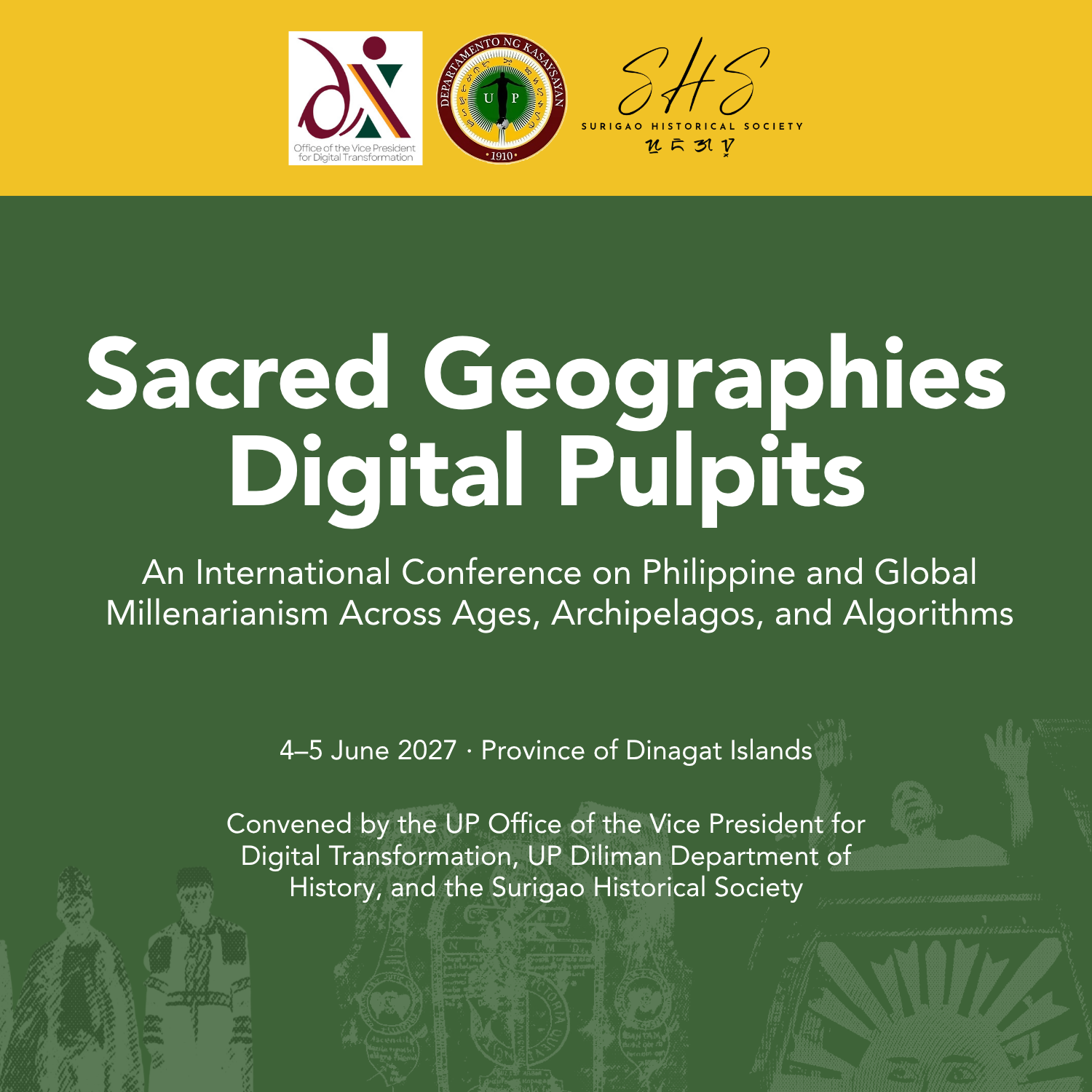
Date:
June 4, 2027-June 5, 2027
Convenors:
UP Office of the Vice President for Digital Transformation
UP Diliman Department of History
Surigao Historical Society
UP Diliman Department of History
Surigao Historical Society
Venue:
Province of Dinagat Islands
Abstract:
In May 1967, two thousand white-clad followers of Valentin de los Santos marched on Malacañang armed with bolos and amulets, certain no bullet could touch them; police cut down thirty-three (Ileto, 1979). In 2023, four hundred bodies were exhumed from Kenya's Shakahola Forest, where a pastor's YouTube ministry had urged his followers to starve their way to Christ. A century and two oceans apart, the grammar holds — grievance, charismatic authority, sacred geography, the conviction that the world as it is cannot be the world as it should be (Cohn, 1970). Only the infrastructure has changed: from a mountain trail one can blockade to an algorithm one cannot. Philippine scholarship has mapped the first world (Ileto, 1979; Sturtevant, 1976; Cannell, 1999); global comparative work has mapped the second (Wessinger, 2011; Hall et al., 2000). The two rarely meet. This conference brings them together, treating Philippine cases as theory-generating rather than merely illustrative — and asks precisely what travels across cases, from a colorum cell to a Telegram channel, and what does not.
Philippine millenarian studies remain Luzon-centric — Banahaw, the Central Luzon colorum heartland, the Lapiang Malaya. The Visayan and Mindanao registers, among them the Pulahanes of Samar and Leyte who mounted the most durable early-American-period resistance (Sturtevant, 1976), receive far less attention than they warrant. The Surigao seaboard offers a case in point: the Surigaonon historian Fernando Almeda (1982) read the 1924 Colorum rising not as fanaticism but as peasant nationalism — Ileto's interpretive move for Luzon, made independently for the seaboard. Convening on the eastern seaboard corrects that, and invites scholarship attentive to the maritime and archipelagic cosmologies the mountain-centered literature has underplayed.
This international conference is a scholarly gathering that brings Philippine and global scholarship on millenarian movements into sustained dialogue — convened in a province building a new state college, and designed to advance that college even as it advances the field We invite abstracts that put Philippine millenarian studies and global comparative scholarship into genuine dialogue, across four tracks:
Sacred Geographies — mountains, islands, and networks as sacred space. How spatial cosmology migrates from the sacred mountains and apocryphal cities of Luzon, to the maritime cosmologies of the eastern seaboard (its island shrines and sacred springs), to networked space where geography seems to dissolve — and how climate displacement manufactures the new dispossessions that have always seeded such movements (Lanternari, 1963).
Charismatic Authority and Its Discontents — from babaylan to televangelist. The mutation of spiritual authority from the indigenous, often female babaylan, through the messianic peasant prophet, to the media-empire founder — centering the succession problem (Weber, 1978; Dawson, 1999) and the marriage of eschatology to prosperity-gospel finance, Quiboloy beside analogues in Lagos, São Paulo, and Seoul.
The State and the Threshold of Violence — Tayug (1931) to Shakahola (2023). How suppression, co-optation, and regulatory neglect shape trajectories — and how the state's own response can trigger violence rather than prevent it (Hall et al., 2000) — from Tayug (1931) and the Pulahanes, through the Lapiang Malaya dispersal, to the Shakahola prosecutions.
Digital Pulpits and Vernacular Categories — thin cults, algorithms, and kulto. Recruiter-less, compound-less “thin” movements that algorithms sustain, and the frameworks built for “thick” cults that cannot reach them (Wessinger, 2011) — paired with the Philippine vocabulary of kulto, sekta, samahan, and simbahan, and what it reveals that the Anglophone debate obscures.
Gender and climate run as cross-cutting threads through all four tracks.
INSTRUCTIONS FOR ABSTRACT PROPOSAL
Graduate students are warmly encouraged.
Submit a 250-word abstract proposal (in MS Word Format) and short bionote to: dinagatinternationalconference@up.edu.ph
Email Heading:
ABSTRACT PROPOSAL Sacred Geographies, Digital Pulpits_SURNAME,First Name
Deadline of abstract submission is on:
31 October 2026, 11:59 PM
In May 1967, two thousand white-clad followers of Valentin de los Santos marched on Malacañang armed with bolos and amulets, certain no bullet could touch them; police cut down thirty-three (Ileto, 1979). In 2023, four hundred bodies were exhumed from Kenya's Shakahola Forest, where a pastor's YouTube ministry had urged his followers to starve their way to Christ. A century and two oceans apart, the grammar holds — grievance, charismatic authority, sacred geography, the conviction that the world as it is cannot be the world as it should be (Cohn, 1970). Only the infrastructure has changed: from a mountain trail one can blockade to an algorithm one cannot. Philippine scholarship has mapped the first world (Ileto, 1979; Sturtevant, 1976; Cannell, 1999); global comparative work has mapped the second (Wessinger, 2011; Hall et al., 2000). The two rarely meet. This conference brings them together, treating Philippine cases as theory-generating rather than merely illustrative — and asks precisely what travels across cases, from a colorum cell to a Telegram channel, and what does not.
Philippine millenarian studies remain Luzon-centric — Banahaw, the Central Luzon colorum heartland, the Lapiang Malaya. The Visayan and Mindanao registers, among them the Pulahanes of Samar and Leyte who mounted the most durable early-American-period resistance (Sturtevant, 1976), receive far less attention than they warrant. The Surigao seaboard offers a case in point: the Surigaonon historian Fernando Almeda (1982) read the 1924 Colorum rising not as fanaticism but as peasant nationalism — Ileto's interpretive move for Luzon, made independently for the seaboard. Convening on the eastern seaboard corrects that, and invites scholarship attentive to the maritime and archipelagic cosmologies the mountain-centered literature has underplayed.
This international conference is a scholarly gathering that brings Philippine and global scholarship on millenarian movements into sustained dialogue — convened in a province building a new state college, and designed to advance that college even as it advances the field We invite abstracts that put Philippine millenarian studies and global comparative scholarship into genuine dialogue, across four tracks:
Sacred Geographies — mountains, islands, and networks as sacred space. How spatial cosmology migrates from the sacred mountains and apocryphal cities of Luzon, to the maritime cosmologies of the eastern seaboard (its island shrines and sacred springs), to networked space where geography seems to dissolve — and how climate displacement manufactures the new dispossessions that have always seeded such movements (Lanternari, 1963).
Charismatic Authority and Its Discontents — from babaylan to televangelist. The mutation of spiritual authority from the indigenous, often female babaylan, through the messianic peasant prophet, to the media-empire founder — centering the succession problem (Weber, 1978; Dawson, 1999) and the marriage of eschatology to prosperity-gospel finance, Quiboloy beside analogues in Lagos, São Paulo, and Seoul.
The State and the Threshold of Violence — Tayug (1931) to Shakahola (2023). How suppression, co-optation, and regulatory neglect shape trajectories — and how the state's own response can trigger violence rather than prevent it (Hall et al., 2000) — from Tayug (1931) and the Pulahanes, through the Lapiang Malaya dispersal, to the Shakahola prosecutions.
Digital Pulpits and Vernacular Categories — thin cults, algorithms, and kulto. Recruiter-less, compound-less “thin” movements that algorithms sustain, and the frameworks built for “thick” cults that cannot reach them (Wessinger, 2011) — paired with the Philippine vocabulary of kulto, sekta, samahan, and simbahan, and what it reveals that the Anglophone debate obscures.
Gender and climate run as cross-cutting threads through all four tracks.
INSTRUCTIONS FOR ABSTRACT PROPOSAL
Graduate students are warmly encouraged.
Submit a 250-word abstract proposal (in MS Word Format) and short bionote to: dinagatinternationalconference@up.edu.ph
Email Heading:
ABSTRACT PROPOSAL Sacred Geographies, Digital Pulpits_SURNAME,First Name
Deadline of abstract submission is on:
31 October 2026, 11:59 PM